
This course provides an overview of lesser-known areas of U.S. GAAP that extend beyond the major accounting standards commonly encountered by CPAs. It explains the accounting requirements for research and development costs, customer acquisition costs, capitalized interest, debt modifications, receivables factoring, government grants, environmental credits and obligations, restructuring activities, financial distress, and subsequent events. The course also explores the recognition, measurement, presentation, and disclosure considerations for these specialized accounting topics, using practical examples to demonstrate how the guidance is applied in real-world financial reporting situations.
Chapter 1: Research & Development - Overview
This chapter provides a clear overview of accounting for research and development activities under ASC 730. It covers the fundamental concepts of R&D, including qualifying costs, recognition requirements, disclosure requirements, and the accounting considerations for uncertainties associated with R&D activities. The chapter also addresses arrangements where outside parties fund R&D, including how to identify obligations, measure costs, and report these transactions. Throughout the chapter, examples illustrate the application of the guidance to common R&D accounting issues and funding arrangements.
Chapter 2: Advertising & Customer Acquisition Costs - Overview
This chapter covers the accounting requirements for advertising costs and costs associated with acquiring and fulfilling customer contracts. It explains when advertising costs are expensed and when certain sales and contract-related costs, such as commissions, onboarding, and setup activities, may be capitalized and amortized over time. The chapter also addresses how to evaluate different types of costs, apply capitalization criteria, determine appropriate amortization periods, and assess whether impairment is required when expected recoveries change.
Chapter 3: Imputed & Capitalized Interest - Overview
This chapter covers the accounting requirements for interest costs under U.S. GAAP, focusing on both imputed interest and capitalized interest. It explains when interest must be imputed due to the absence of a stated rate or when transaction terms are not at market, including how to determine the appropriate interest rate and record the related amounts. The chapter also addresses the capitalization of interest costs associated with the construction or production of qualifying assets, including how to identify qualifying assets, calculate capitalizable interest, and apply the guidance during the capitalization period. Together, these concepts provide an understanding of how interest costs are recognized and reflected in financial statements.
Chapter 4: Debt Modifications - Overview
This chapter provides an overview of the accounting guidance for debt modifications and exchanges under ASC 470-50. It explains how to determine whether changes in debt terms result in an extinguishment, including key concepts such as identifying the debtor and creditor, evaluating transactions involving third-party intermediaries, and applying the 10% cash flow test. The chapter also addresses the accounting treatment for fees and costs associated with debt modifications, including fees exchanged between debtors and creditors, third-party costs, and modifications to revolving debt arrangements. Throughout the chapter, examples illustrate how to evaluate whether a debt modification requires extinguishment accounting or continuation of the existing debt arrangement.
Chapter 5: Receivables Factoring - Overview
This chapter provides an overview of the accounting and reporting requirements for accounts receivable factoring arrangements. It explains how entities use factoring programs to accelerate cash collections by transferring customer receivables to financial intermediaries and addresses the conditions that must be met for a transfer to qualify as a true sale rather than a secured borrowing. The chapter also covers the key considerations involved in evaluating receivable transfers and determining the appropriate financial statement treatment under U.S. GAAP.
Chapter 6: Government Grants - Overview
This chapter covers the accounting and financial reporting requirements for government grants under U.S. GAAP. It explains how to determine whether an arrangement qualifies as a grant, distinguish between asset-related and income-related assistance, and evaluate when recognition is appropriate based on the likelihood of satisfying applicable conditions. The chapter also addresses presentation on the balance sheet and income statement, required disclosures, and potential repayment obligations. Throughout the chapter, examples illustrate how to apply the guidance to ensure financial statements accurately reflect the effects of government support.
Chapter 7: Environmental Credits & Obligations - Overview
This chapter provides an overview of the accounting requirements for environmental credits and environmental credit obligations under ASC 818. It explains the criteria used to determine whether an environmental credit qualifies for recognition as an asset, including the requirement that the credit represents a transferable right, along with the related recognition, initial measurement, subsequent measurement, impairment, classification, derecognition, and disclosure requirements. The chapter also addresses the accounting for environmental credit obligations, including when a liability should be recognized, how funded and unfunded obligations are measured, and how these liabilities are subsequently measured and derecognized. Throughout the chapter, key judgments involved in applying the guidance are discussed to help ensure these transactions are properly reflected in the financial statements.
Chapter 8: Restructuring & Termination Costs - Overview
This chapter covers the accounting requirements for restructuring costs, including workforce reductions and contract terminations, under ASC 420. It explains how to identify exit and disposal cost obligations, determine when liabilities should be recognized, and measure the related obligations. The chapter also addresses the presentation and disclosure requirements under U.S. GAAP to help ensure restructuring activities are appropriately reflected in the financial statements.
Chapter 9: Financial Distress & Reorganization - Overview
This chapter covers the accounting and financial reporting requirements for entities experiencing financial distress, including going concern evaluations under ASC 205-40 and reporting requirements for entities in Chapter 11 reorganization under ASC 852. It explains management’s responsibility to assess whether substantial doubt exists, the required look-forward period, the impact of mitigation plans, and the related disclosure requirements. The chapter also addresses accounting and presentation considerations during bankruptcy proceedings, including liabilities subject to compromise, reorganization items, professional fees, and required disclosures. Throughout the chapter, examples illustrate how financial reporting changes as entities navigate financial uncertainty and reorganization.
Chapter 10: Subsequent Events - Overview
This final chapter provides an overview of the accounting and financial reporting requirements for subsequent events under U.S. GAAP. It explains the distinction between recognized and nonrecognized subsequent events, the related financial statement and disclosure requirements, and the key considerations involved in evaluating events that occur after the balance sheet date. The chapter also addresses management responsibilities, audit implications, and common examples of subsequent events to help illustrate how post-balance-sheet developments should be evaluated and reported.
<iframe src="//player.vimeo.com/video/451918666?autoplay=1" allowfullscreen="" frameborder="0" height="357" mozallowfullscreen="" webkitallowfullscreen="" width="635"></iframe>
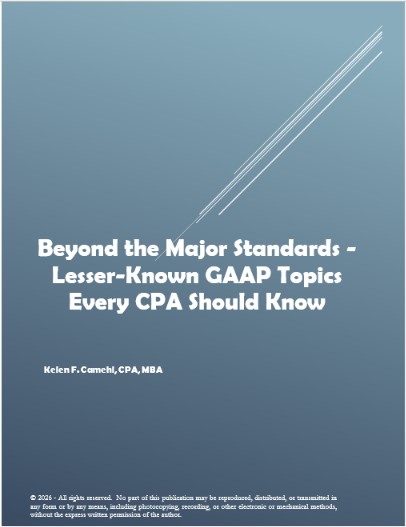
This course provides an overview of lesser-known areas of U.S. GAAP that extend beyond the major accounting standards commonly encountered by CPAs.
No advanced preparation or prerequisites are required for this course.
- Identify the key components that define research and development activities.
- Discover and distinguish between research and development as separate concepts.
- Recognize the scope and scope exceptions applicable to R&D under ASC 730-10.
- Discover and determine the recognition requirements for R&D costs.
- Recognize and recall the disclosure requirements related to R&D in financial statements.
- Identify the scope of ASC 730-20 for R&D arrangements.
- Discover and differentiate between obligations to repay funds and obligations to perform contractual services under R&D arrangements.
- Recognize how subsequent measurement of R&D arrangements is handled.
- Discover and determine required disclosures related to research and development arrangements
- Identify the types of advertising costs that must be expensed under U.S. GAAP.
- Discover and determine when direct-response advertising costs can be capitalized.
- Discover and differentiate between production costs and communication costs in advertising activities.
- Recognize the disclosure requirements related to advertising expenses.
- Identify costs that qualify for capitalization as costs to obtain or fulfill a contract.
- Discover and differentiate between costs that must be expensed immediately and those that can be capitalized.
- Discover and determine the appropriate amortization methods and periods for capitalized contract costs.
- Identify indicators that capitalized contract costs may be impaired.
- Identify situations where imputed interest must be recognized under U.S. GAAP.
- Discover and determine the appropriate interest rate to use when imputing interest.
- Recognize the financial statement impact of recording imputed interest.
- Discover and distinguish between arrangements that require imputation and those that do not
- Identify assets that qualify for interest capitalization.
- Discover and determine the amount of interest cost eligible for capitalization.
- Recognize the period during which interest must be capitalized.
- Discover and distinguish between interest costs that are capitalized and those that must be expensed.
- Identify the scope and application of ASC 470 50 for debt modifications and exchanges.
- Discover and determine whether a debt modification or exchange results in an extinguishment.
- Recognize the factors used to evaluate debtor, creditor, and third-party intermediary relationships.
- Discover and determine how to apply the 10% cash flow test for debt modifications and exchanges.
- Identify the accounting treatment for fees, costs, and revolving debt arrangements.
- Recognize key characteristics as well as advantages/disadvantages of factoring arrangements.
- Identify the U.S. GAAP area applicable to factoring arrangements.
- Identify and list the three specific conditions that must be met for a factoring arrangement to qualify as a sale.
- Recognize key evaluation considerations relating to true sale opinions.
- Identify examples of continuing involvement.
- Recognize the impact from a failed sale in a factoring arrangement.
- Identify what qualifies as a government grant under U.S. GAAP.
- Discover and distinguish between grants related to assets and grants related to income.
- Recognize the criteria for when a government grant can be recorded in the financial statements.
- Discover and determine the appropriate methods for presenting grants on the balance sheet and income statement.
- Recall the required disclosures for government grants, including repayment obligations and key terms.
- Identify the criteria for an environmental credit under ASC 818.
- Discover and determine when environmental credits qualify for asset recognition.
- Discover and distinguish between compliance and noncompliance environmental credits.
- Recognize the measurement, impairment, derecognition, and disclosure requirements for environmental credits.
- Identify when an environmental credit obligation liability should be recognized under ASC 818-30.
- Discover and distinguish between the funded and unfunded portions of an environmental credit obligation liability.
- Discover and determine the appropriate measurement of an environmental credit obligation liability.
- Recognize the derecognition and disclosure requirements for environmental credit obligation liabilities.
- Identify the types of restructuring costs within the scope of ASC 420.
- Recognize the criteria for determining when exit and disposal cost obligations should be recorded.
- Discover and differentiate between the timing and measurement requirements for restructuring liabilities.
- Recognize reporting and disclosure requirements related to restructuring costs.
- Identify the conditions that require management to evaluate going concern uncertainty.
- Discover and determine the appropriate one-year look-forward period for a going concern assessment.
- Recognize how management’s plans may alleviate substantial doubt.
- Discover and differentiate between disclosures required when substantial doubt is alleviated and when it is not.
- Identify when an entity is required to apply ASC 852 accounting guidance for reorganization.
- Recognize how to present liabilities subject to compromise and reorganization items.
- Discover and differentiate between normal operating expenses and reorganization-related costs.
- Discover and determine the appropriate financial statement presentation during and after Chapter 11 proceedings.
- Recognize required disclosures for entities undergoing reorganization under ASC 852.
- Identify the key characteristics and timing of subsequent events under ASC 855.
- Discover and differentiate between recognized and nonrecognized subsequent events.
- Discover and determine when financial statement adjustments are required versus disclosure.
- Recognize common examples of subsequent events and their typical accounting treatment.
- Recognize audit procedures and documentation requirements related to subsequent events.
CPE Course
on_demand
CPA, CMA, CFE, CGFM, CIA, CRMA
Online
No advanced preparation or prerequisites are required for this course.

NASBA Sponsor Number: 109504
State of New York Sponsor Number: 002746
State of Texas Sponsor Number: 009890
Online
Online
No advanced preparation or prerequisites are required for this course.
Online
No advanced preparation or prerequisites are required for this course.
Online
No advanced preparation or prerequisites are required for this course.
Online
Online
No advanced preparation or prerequisites are required for this course.

Recognized CPE provider, authorized by the Institute of Internal Auditors for use in the Certified Internal Auditor (CIA) CPE program.
Online
No advanced preparation or prerequisites are required for this course.
Recognized CPE provider, authorized by the Institute of Internal Auditors for use in the Certified Risk Management Assurance (CRMA) CPE program.
Online
No advanced preparation or prerequisites are required for this course.
 | This activity, ID No. 19 ILL 000 has been approved for 1.0 Recertification Credit Hour(s) toward CPP recertification through the American Payroll Association (APA). Please make note of the Course Code on your CPP Recertification Log. For more information about certification or recertification, please visit the APA website at www.americanpayroll.org. |

This program has been approved for 12 Recertification Credit Hour(s) toward CPP recertification through the American Payroll Association (APA). For more information about certification or recertification, please visit the APA homepage at www.americanpayroll.org.
Online
No advanced preparation or prerequisites are required for this course.
| This activity, ID No. 19 ILL 000 has been approved for 1.0 Recertification Credit Hour(s) toward CPP recertification through the American Payroll Association (APA). Please make note of the Course Code on your CPP Recertification Log. For more information about certification or recertification, please visit the APA website at www.americanpayroll.org. |
This program has been approved for 12 Recertification Credit Hour(s) toward RCH recertification through the American Payroll Association (APA). For more information about certification or recertification, please visit the APA homepage at www.americanpayroll.org.
On Demand/Online
No advanced preparation or prerequisites are required for this course.

Approved for up to 2.4 CTP/CCM recertification credits by the Association for Financial Professionals
On Demand/Online
No advanced preparation or prerequisites are required for this course.

Approved for up to 2.4 FP&A recertification credits by the Association for Financial Professionals
Online
No advanced preparation or prerequisites are required for this course.
 | This activity, ID No. XXXXXX has been approved for #### CPE credit hours toward IRS Enrolled Agent (EA) continuing education requirements. In accordance with the standards set forth in Circular 230 section 10.6, CE credits have been granted based on a 50-minute hour. |
Online
Online
Online
Recognized CPE provider, authorized by the Institute of Internal Auditors for use in the Certified Risk Management Assurance (CRMA) CPE program.
Online
Online
Online
No advanced preparation or prerequisites are required for this course.
 | This activity, ID No. XXXXXX has been approved for #### recertification credit hours toward SHRM-CP™ and SHRM-SCP™ recertification through the Society of Human Resource Management® (SHRM®). Please make note of the activity ID number on your recertification application form. For more information about certification or recertification, please visit the Society for Human Resource Management website at www.shrm.org. |
Illumeo is recognized by SHRM to offer Professional Development Credits (PDCs) for the SHRM-CP℠. This program is valid for 2 PDCs for the SHRM-CP℠. For more information about certification or recertification, please visit www.shrmcertification.org.
Online
No advanced preparation or prerequisites are required for this course.
| This activity, ID No. XXXXXX has been approved for #### recertification credit hours toward SHRM-CP™ and SHRM-SCP™ recertification through the Society of Human Resource Management® (SHRM®). Please make note of the activity ID number on your recertification application form. For more information about certification or recertification, please visit the Society for Human Resource Management website at www.shrm.org. |
Illumeo is recognized by SHRM to offer Professional Development Credits (PDCs) for the SHRM-SCP℠. This program is valid for 2 PDCs for the SHRM-SCP℠. For more information about certification or recertification, please visit www.shrmcertification.org.
Online
No advanced preparation or prerequisites are required for this course.
 | This activity, ID No. 000000 has been approved for 1.0 HR (General) recertification credit hours toward aPHR™, PHR®, PHRca®, SPHR®, GPHR®, PHRi™ and SPHRi™ recertification through HR Certification Institute® (HRCI®). Please make note of the activity ID number on your recertification application form. For more information about certification or recertification, please visit the HR Certification Institute website at www.hrci.org. |

The use of this seal confirms that this activity has met HR Certification Institute’s® (HRCI®) criteria for recertification credit pre-approval.
Online
No advanced preparation or prerequisites are required for this course.
| This activity, ID No. 000000 has been approved for 1.0 HR (General) recertification credit hours toward aPHR™, PHR®, PHRca®, SPHR®, GPHR®, PHRi™ and SPHRi™ recertification through HR Certification Institute® (HRCI®). Please make note of the activity ID number on your recertification application form. For more information about certification or recertification, please visit the HR Certification Institute website at www.hrci.org. |
The use of this seal confirms that this activity has met HR Certification Institute’s® (HRCI®) criteria for recertification credit pre-approval.